
When You Have to Evacuate: Emergency and Disaster Planning Across California's Residential Care Facilities
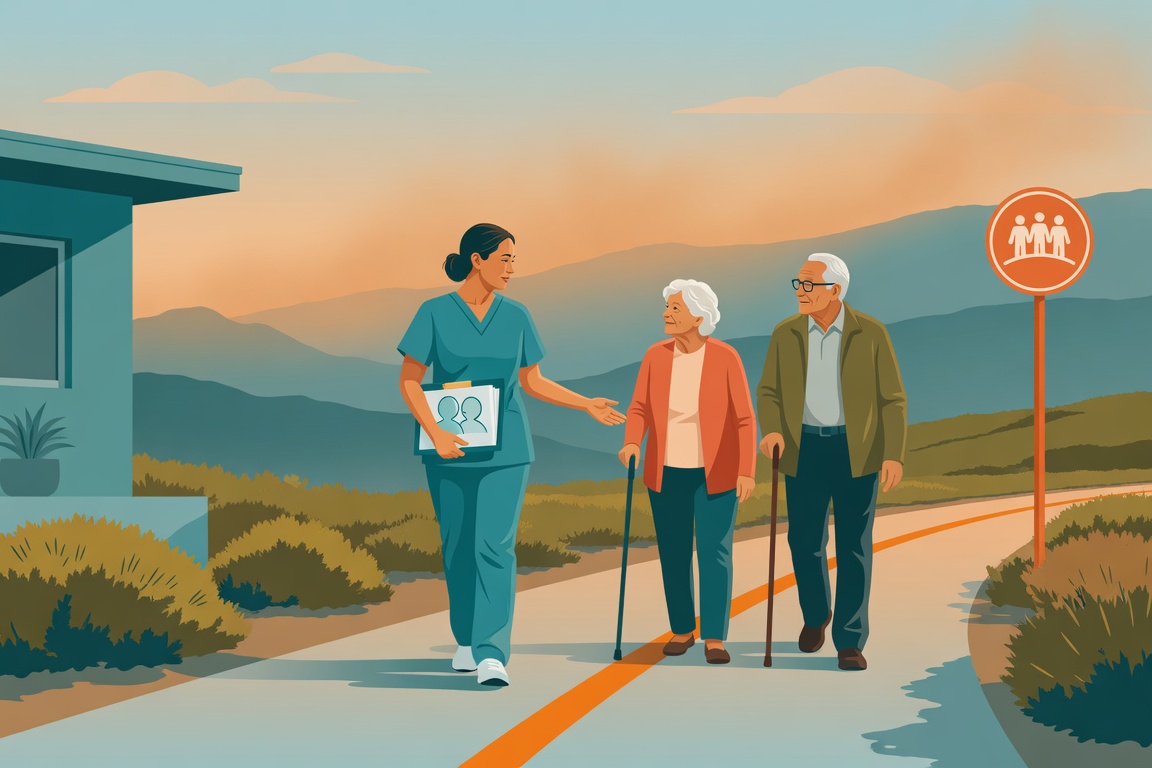
A wildfire doesn’t check your license type before it crosses the ridge. Neither does a power failure, an earthquake, or the public-safety power shutoff that takes your block dark for two days. Every residential care home in California has to be able to keep frail people safe when the building turns hostile — and, when it comes to it, get them out. That part is universal.
What isn’t universal is the rulebook. The same medical-versus-custodial split that decides who surveys you also decides what your disaster plan has to contain, how often you drill it, and who you have to show it to. And disaster planning adds a dimension that ordinary compliance doesn’t: it has a physical test. A care plan that exists only in a binder still passes a survey. A disaster plan that exists only in a binder gets people hurt when the binder is on fire.
Here’s how emergency and disaster planning actually works across SNFs, CLHFs, assisted living, RCFEs, and board & care — and why the plan is only ever as good as the records you can carry out the door.
Two regulators, two disaster rulebooks
If you’ve read our survey-readiness map, the dividing line will be familiar, because it’s the same one. Two separate agencies split the field along a medical line, and disaster planning lives on both sides of it.
- The California Department of Public Health (CDPH) regulates health facilities — skilled nursing facilities (SNFs) and congregate living health facilities (CLHFs) — under Title 22, Division 5. On this side, the disaster program is a clinical instrument: it has to account for patients who can’t be moved without medical planning, for continuity of skilled nursing through the event, and for emergency discharge of those who can go.
- The California Department of Social Services (CDSS), through Community Care Licensing (CCL), regulates community care facilities — Residential Care Facilities for the Elderly (RCFEs), Adult Residential Facilities (ARFs), and the small homes people call board & care — under Title 22, Division 6, with a dedicated emergency-planning statute on top: Health & Safety Code §1569.695 for RCFEs.
Same hazard, two playbooks. A facility group that runs both a CLHF and an RCFE has to keep two disaster frameworks straight — and, as with incident reporting, a surveyor will check that you ran the right one.
The health-facility side: a federal layer on top of Title 22
SNFs carry the heaviest emergency-planning load, because they answer to two masters at once.
The state rule. Title 22 §72551 requires every SNF to maintain an External Disaster and Mass Casualty Program — a plan that is realistic, tailored to the facility’s actual situation and surroundings, and kept current at all times, not dusted off annually. It has to cover procedures for the emergency discharge of patients who can safely go into the community, including their transportation, their continued care, and a follow-up inquiry within 24 hours to confirm they landed safely. Every staff member must be trained to the plan and ready to execute it at any hour; new employees are oriented to it on day one. SNFs run external disaster drills twice a year and must participate in local and state disaster exercises when asked.
The federal rule. Because SNFs are CMS-certified, they also fall under the CMS Emergency Preparedness Rule (42 CFR §483.73), which is built on four core elements:
- An emergency plan grounded in a facility- and community-based all-hazards risk assessment — fire, flood, earthquake, power loss, infectious outbreak, the works.
- Policies and procedures that operationalize the plan, including subsistence needs, tracking residents and staff during and after an evacuation, and sheltering in place.
- A communication plan with current contacts for staff, responders, and other providers, and a way to share resident clinical information when people are moved.
- A training and testing program — training at least annually, and two exercises a year, one of them ideally a full-scale, community-based exercise and the other an exercise of the facility’s choosing.
Where CLHFs sit. Congregate living health facilities are CDPH health facilities under the same Division 5 umbrella, held to the Title 22 disaster-program standard at small-facility scale — the same disproportionate weight that makes every CLHF obligation feel heavy for a six-resident home. They must also carry a valid fire clearance from the authority having jurisdiction, issued against the State Fire Marshal’s fire and life-safety standards, and keep it current. A small home providing skilled nursing doesn’t get a lighter disaster standard for being small; it gets the health-facility standard in a building with a residential footprint.
The community-care side: §1569.695 is more demanding than people remember
Operators who think of assisted living as the “lighter” regulatory world are often working from an outdated picture of disaster planning. After the 2017–2018 wildfire seasons exposed RCFEs that evacuated chaotically — or didn’t evacuate at all — California rewrote the rules. AB 3098, effective January 1, 2019, put real teeth into HSC §1569.695, and the result is one of the more prescriptive emergency-planning statutes in residential care.
Every RCFE (and the small board & care homes licensed as one) must maintain a written emergency and disaster plan — documented on the LIC 610E — that includes, concretely:
- 72-hour self-reliance. The facility must be able to operate on its own for not less than 72 hours after a disaster, including through a loss of water, sewer, gas, or electricity, with alternative resources and supplies on hand.
- Evacuation procedures with a named assembly point, and that assembly point has to appear on the facility sketch — not described vaguely, but mapped.
- At least two shelter locations, with one of them outside the immediate vicinity, so a neighborhood-wide event doesn’t strand everyone at a destination that’s also evacuating.
- Transportation and access details — emergency routes, communication with responders, and vehicle keys reachable on every shift (a plan that depends on the one manager who has the van keys is not a plan).
- Evacuation chairs at each stairwell, required since July 1, 2019 — a physical-equipment mandate, not a paperwork one.
- Quarterly drills, for each shift, with the type of emergency varied from quarter to quarter so the night staff has actually rehearsed a fire and not just an earthquake. Residents don’t have to participate, but staff do.
- Plan availability. The plan must be available on request to residents, their responsible parties, the local long-term care ombudsman, and local emergency responders — and CCL confirms at the annual licensing visit that it’s on file with the required content. New applicants submit it with the initial license application.
ARFs and board & care homes operate under the parallel Division 6 framework (Title 22 §87212 and related sections). The headline for any operator who still pictures Community Care Licensing as hands-off: the disaster expectations tightened sharply, they’re checked every year, and several of them — evacuation chairs, the mapped assembly point, the keys-on-every-shift rule — are pass/fail physical facts, not narrative you can soften.
The records you have to be able to carry out the door
Here is where disaster planning stops being about the building and becomes about the record — and where the two regulatory worlds quietly converge.
Read the two rulebooks side by side and the same list of documents shows up, because you cannot safely move a vulnerable person without it:
- A current resident roster — on the RCFE side, §1569.695 specifies names with dates of birth — so you can account for every person at the assembly point and at the shelter.
- Each resident’s medication list, accurate as of today, so care continues at the destination and nobody misses an insulin dose because the MAR or the medication record stayed behind.
- Care plans or needs-and-services plans, so the receiving site knows what each person actually requires.
- Physician and responsible-party contacts, so you can notify families and clinicians without reconstructing a phone tree from memory.
- On the SNF side, the clinical information that has to travel with a transferred patient under both §72551 and the CMS communication-plan element.
Notice what every item has in common: it’s only useful if it’s current and retrievable at a moment’s notice. A roster that’s three admissions out of date, a medication list someone meant to update, a care plan in a binder in the office that’s now behind the fire line — each is a planning document that fails exactly when the plan is invoked. The disaster requirement isn’t really “have these documents.” It’s “have these documents live, and be able to take them with you in the ninety seconds you get.”
The throughline: a plan is only as good as the record behind it
Step back and the same operational truth holds across every facility type on this list — and it’s the same truth that governs survey readiness:
The facilities that come through a disaster well don’t assemble the record when the alarm sounds. They keep a complete, current, retrievable resident record as a byproduct of daily care — so when they have to evacuate, the information walks out the door with the people.
The specifics differ by license. SNFs and CLHFs run a Title 22 disaster-and-mass-casualty program under CDPH, with the federal CMS rule layered on for skilled nursing and a State Fire Marshal clearance for the building. RCFEs, ARFs, and board & care run the §1569.695 framework under Community Care Licensing — 72-hour self-reliance, mapped assembly points, evacuation chairs, quarterly per-shift drills. The forms and the agencies on the letterhead change.
But the shape of the work is identical, and most of it is the work you should already be doing every day:
- Keep the resident roster, medication records, and care or service plans current — because those are the documents you evacuate with, not just the ones you survey with.
- Make the whole record retrievable in seconds, from anywhere — a record you can’t reach from a parking lot at 2 a.m. isn’t part of your disaster plan.
- Drill the plan on the schedule your license demands — twice a year on the health-facility side, quarterly per shift on the community-care side — and keep the documentation that proves you did.
- Keep the plan itself current and on file, with the physical pieces (assembly point on the sketch, chairs at the stairwells, keys on every shift) actually in place.
- Know which agency and which form govern your facility, so you’re planning to the right standard and not the neighbor’s.
Do those things continuously and an evacuation order is a hard day, not a catastrophe. The hazard doesn’t care about your license type — but the regulator does, and so does the family asking whether their mother’s medications made it out with her.
CLHF Engine is built for exactly this — across facility types. Resident rosters, electronic medication records, care and service plans, and contact information kept current as a byproduct of daily care and retrievable from any device, so the record that keeps you survey-ready is the same record that walks out the door in an evacuation. For congregate living homes it also handles HCBA Waiver TARs and nursing notes; for skilled nursing, assisted living, and board & care it’s the same record-keeping rigor without enterprise-hospital bloat. See how it fits your facility.
This article is a general overview of California residential care emergency and disaster planning requirements as of 2026, drawn from Health & Safety Code §1569.695 (as amended by AB 3098), Title 22 CCR (Division 5 §72551 and Division 6 §87212), the federal CMS Emergency Preparedness Rule at 42 CFR §483.73, and CDPH and CDSS Community Care Licensing guidance. Regulations, forms, and drill schedules change and vary by license category — confirm the current rules for your specific facility type before relying on anything here for a compliance decision.